
Open cell and closed cell
Spray Foam Insulation in Panama City, FL
One material that seals the air leaks and insulates in the same pass, applied where it earns its cost.
- Free on-site estimates
- Foam type, thickness and R-value written out for each area
- Roof leaks and wet framing flagged before anything is covered
What Spray Foam Does in a Gulf Coast House
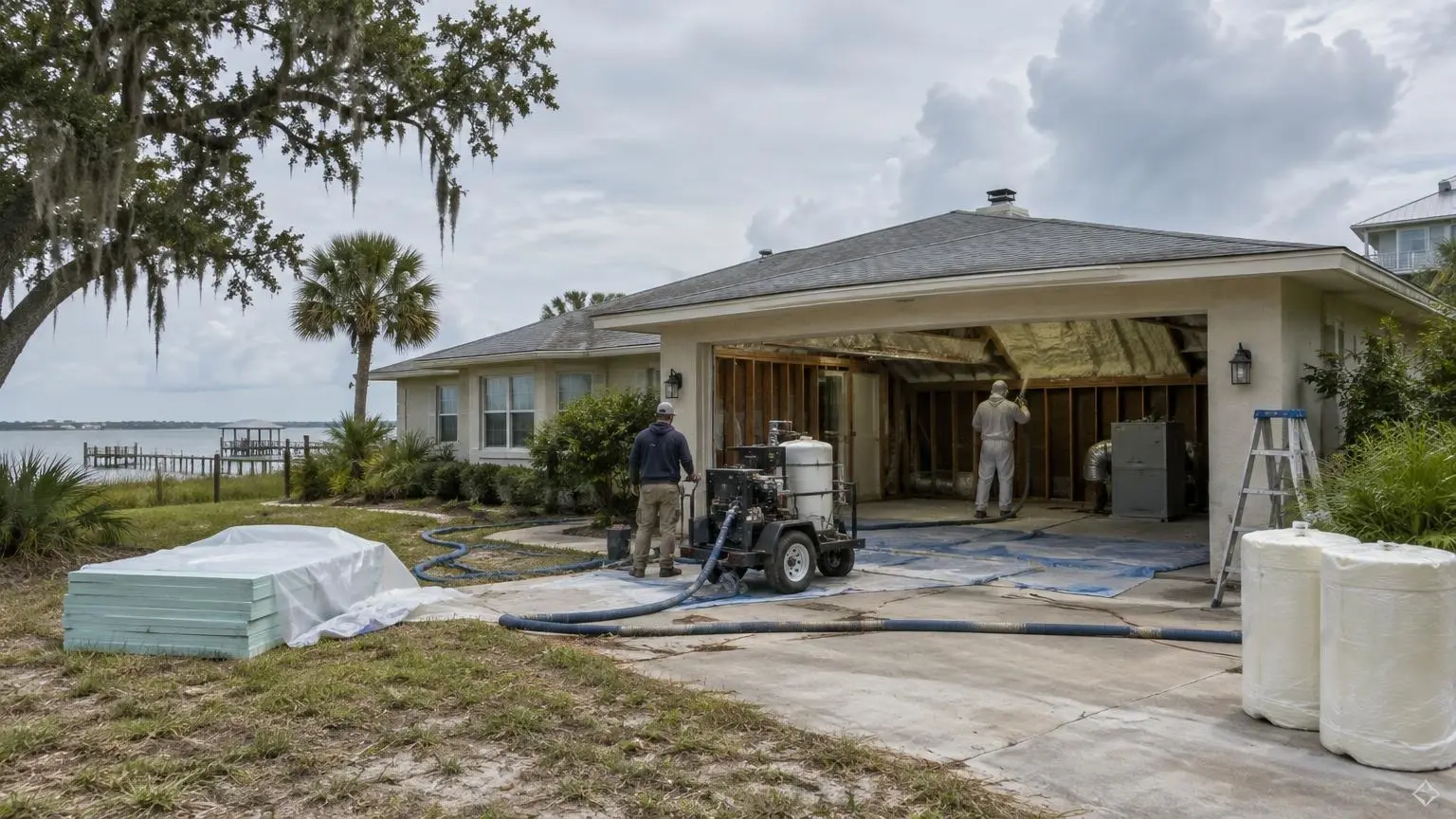
Spray foam insulation is a two-part liquid that reacts as it leaves the gun, expands, and sets into a solid layer stuck to the surface it hits. Unlike batts or loose fill, it closes the cracks and holes it covers, so it stops air from moving as well as slowing heat. In Panama City that matters because the load on a house is not only heat. Humid outdoor air leaking in carries moisture the air conditioner has to pull out, and that latent load is a big part of why AC systems here run so long. Sealing the leaks cuts both.
Open-cell foam
Open-cell foam is light and spongy, with cells that are not fully closed. HomeGuide rates it at R-3.5 to R-3.7 per inch and prices it at $1.50 to $3.50 per square foot installed. It expands a lot, so it fills rafter bays and wall cavities fully, around wires and odd framing. It lets some water vapor through, which can be useful because it lets a roof deck dry inward if it ever gets a little wet. It also deadens sound, which owners of rentals and condos near the beach tend to like. Its main use around Panama City is under the roof deck in a sealed attic and inside walls.
Closed-cell foam
Closed-cell foam is denser and harder. HomeGuide rates it at R-5 to R-7 per inch and lists it at $3.00 to $5.00 per square foot. At typical thickness it acts as a vapor retarder and does not absorb water, and it adds rigidity to the panel or sheathing it bonds to. We use it on the underside of raised floors where the space below is damp, on steel walls and roofs of metal buildings, at rim areas and band boards, and in spots too shallow for enough open-cell. It costs more per inch, so we do not use it where open-cell or blown-in would do the job.
Where foam pays off here
The sealed attic is the most common foam job in Bay County. Many homes have ducts and an air handler in the attic, where summer heat is fierce. Foam on the underside of the roof deck and gable walls brings that space inside the thermal envelope, so the ducts sit in air near house temperature instead of in an oven. Other jobs where foam makes sense: walls opened up during a remodel or storm repair, bonus rooms over garages, cathedral ceilings with no attic, the floors of raised beach houses, and metal shops and barns. Each one has a slightly different spec, and we write it up area by area.
What the job looks like
Foam is sprayed in layers, or lifts, to the thickness on the quote, because spraying too thick in one pass can make the foam overheat or cure badly. The house has to be cleared of people and pets during spraying, and HomeGuide advises staying out for at least 24 hours while the foam cures. In attics and crawl spaces the foam often needs an ignition barrier coating, and in living areas a thermal barrier such as drywall; we tell you which applies. Before we spray a roof deck, we look for leaks and soft decking, because foam over a wet deck traps the problem.
Is spray foam a red flag?
Some buyers and inspectors are wary of foam on roof decks because it hides the underside of the roof, and a bad install can leave odor or gaps. The answer is a careful install and records. We spray only over a sound, dry roof, keep to the manufacturer's lift thickness, and give you a written record of the foam type, thickness and areas covered. That paperwork helps when you sell.
Not sure foam is right for your house? Ask us to price it next to blown-in. Get a free estimate
Where We Spray
The foam and thickness change with the surface and the moisture risk.
Roof deck foam for sealed attics
Open-cell under the decking and gable walls so ducts and the air handler sit inside the envelope.
Wall cavities
Open-cell or closed-cell in open stud bays during remodels, additions and storm repairs.
Raised floors
Closed-cell on the underside of floors over open or damp crawl spaces and pilings.
Bonus rooms over garages
Foam in the floor, kneewalls and slopes of rooms that bake in summer.
Cathedral ceilings
Closed-cell where shallow rafters leave little room for anything else.
Metal buildings
Closed-cell on steel walls and roofs to stop condensation and heat gain.
Published Spray Foam Insulation Costs
| Job | Range and source |
|---|---|
| Spray foam, installed | $1.50 to $5.00 per sq ft (HomeGuide) |
| Open-cell / closed-cell | $1.50 to $3.50 / $3.00 to $5.00 per sq ft (HomeGuide) |
| About 1,000 sq ft | $1,500 to $5,000 (HomeGuide); $3,150 to $7,500 existing home (Fixr) |
| Existing walls / new construction | $3.15 to $7.50 / $2.75 to $6.50 per sq ft (Fixr) |
| Attic | $3,000 to $8,000 (HomeGuide) |
| All exterior walls | $4,000 to $10,000 (HomeGuide) |
| Whole house | $8,000 to $20,000 (HomeGuide); $10,000 to $30,000 (Fixr) |
| Typical job minimum | $1,000 to $2,000+ (HomeGuide) |
National ranges from HomeGuide's 2026 guide and Fixr's 2025 guide, shown for budgeting. Foam type, thickness, access and prep work move the figure up or down, and small jobs often hit a minimum. You pay what your written estimate says, nothing more.
How a Spray Foam Job Runs
1. Look
Inspect the surfaces, check the roof deck and framing for moisture, and measure the areas.
2. Spec
Pick open-cell or closed-cell per area, set thickness and R-value, and put it in a written quote.
3. Prep
Cover floors and belongings, mask windows and fixtures, and set up ventilation.
4. Spray
Apply foam in lifts to the quoted thickness, then add ignition or thermal barrier where required.
5. Check
Measure thickness, trim where needed, clean up and walk you through what was done.
Why Choose Us for Spray Foam Insulation
Foam only where it fits
If blown-in or a sealed ceiling would do the job for less, we say so.
Thickness in writing
Each area on the quote shows inches of foam and the resulting R-value.
Dry roof first
We do not spray over leaks or soft decking.
Spray Foam Insulation Questions
What is the difference between spray foam and other insulation?
Batts and loose fill slow heat but let air pass through them, so they work best over a sealed surface. Spray foam seals the surface it is sprayed on and insulates in the same layer. That is why it is used on roof decks, rim areas and raised floors, where air sealing with other materials is hard.
Does open-cell foam on the roof deck hide roof leaks?
It can slow how fast a leak shows up inside, which is why we check the roof first and spray only over dry, sound decking. Open-cell does let some moisture pass, so a leak usually shows as a damp spot on the foam rather than staying hidden for long.
How thick does the foam need to be?
It depends on the target R-value and the foam. At HomeGuide's R-3.5 to R-3.7 per inch, open-cell needs roughly 5.5 inches to reach about R-20. Closed-cell at R-5 to R-7 per inch gets there in about 3 to 4 inches. Your quote lists the thickness for each area.
Does spray foam smell?
There is an odor while it is sprayed and during curing, which is why everyone stays out of the house for at least 24 hours per HomeGuide's guidance and the area is ventilated. A properly mixed and cured install should not keep smelling after that.
Can you spray foam in an occupied home?
Yes, but not with people inside during spraying and curing. We schedule the job so you can be away for the day and night it takes, and we seal off the work area.
Spray Foam Insulation Service Areas
- Spray Foam Insulation in Panama City, FL
- Spray Foam Insulation in Panama City Beach, FL
- Spray Foam Insulation in Lynn Haven, FL
- Spray Foam Insulation in Callaway, FL
- Spray Foam Insulation in Parker, FL
- Spray Foam Insulation in Springfield, FL
- Spray Foam Insulation in Upper Grand Lagoon, FL
- Spray Foam Insulation in Lower Grand Lagoon, FL
- Spray Foam Insulation in Laguna Beach, FL
- Spray Foam Insulation in Mexico Beach, FL
- Spray Foam Insulation in Southport, FL
- Spray Foam Insulation in Fountain, FL
- Spray Foam Insulation in Wewahitchka, FL
- Spray Foam Insulation in Port St. Joe, FL
- Spray Foam Insulation in Inlet Beach, FL
- Spray Foam Insulation in Sunny Hills, FL
Get a Spray Foam Insulation Estimate
Tell us which areas you are thinking about. We will look and give you a written price with foam type and thickness for each one.