
Homes, beach rentals and metal shops around St. Andrews Bay
Spray Foam Insulation in Panama City, FL
Cooler rooms and lower AC bills in a humid Gulf Coast summer: foam where it pays, blown-in where it costs less, all priced in writing.
- Free on-site estimates
- Foam type, thickness and R-value written out for each area
- Roof leaks and wet framing flagged before anything is covered
Insulation for Long, Hot, Humid Summers
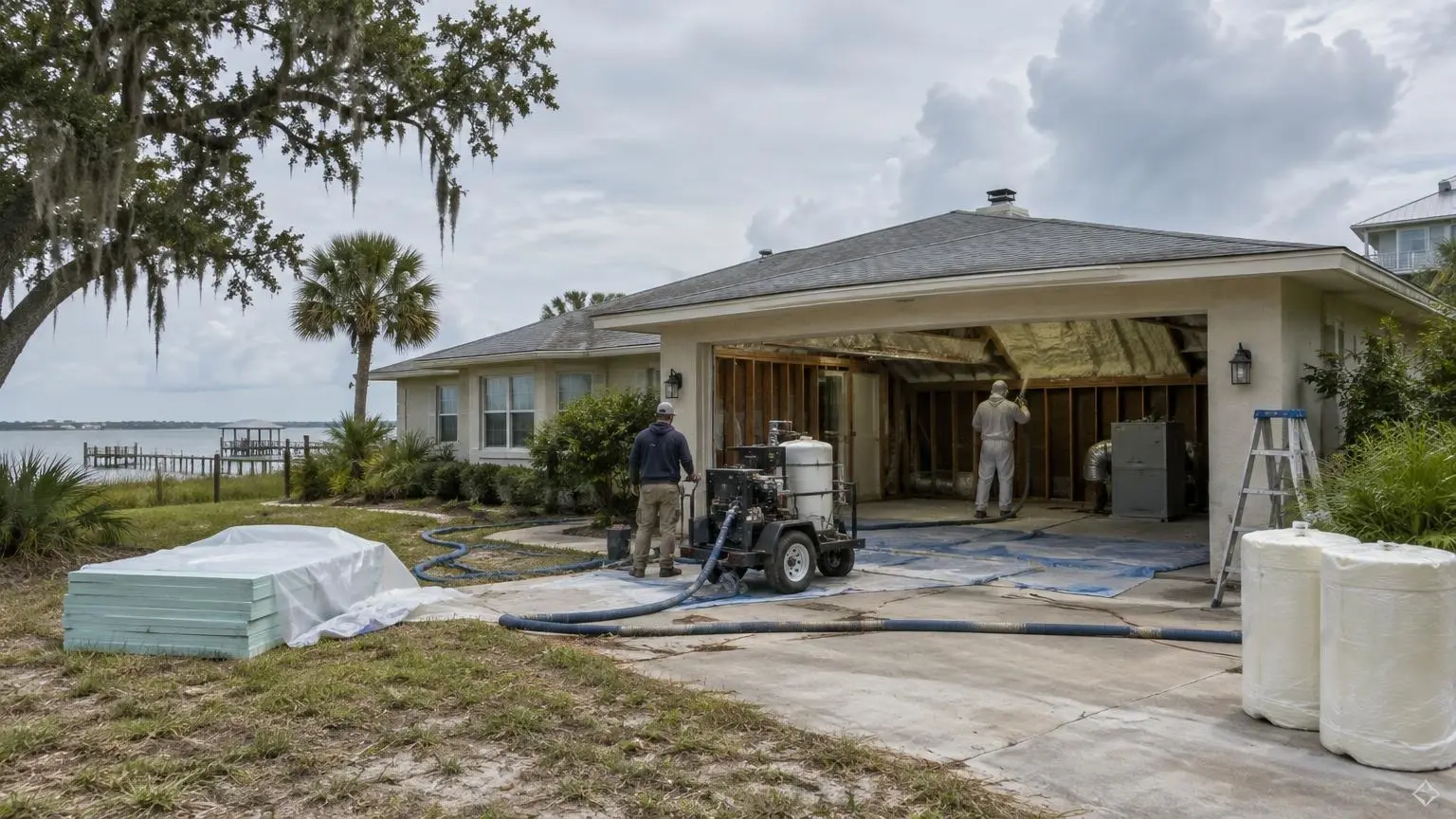
Spray foam insulation in Panama City is mostly about keeping heat and humidity out. Panama City's climate table on Wikipedia shows a July average high of 91.1F, about 61 inches of rain a year, and a humid subtropical pattern of long, hot, sticky summers with short, mild winters. In most houses here the air conditioner runs from spring into fall, and much of the ductwork sits in an attic that can bake well above the outdoor temperature. We seal and insulate those attics, walls, floors and outbuildings with open-cell or closed-cell spray foam where it is the right tool, and with blown-in insulation where that gets the same result for less money.
What the code and the Department of Energy ask for
Bay County sits in Climate Zone 2A on the ASHRAE climate map that the energy code uses, the hot and humid band that covers the Florida Panhandle. The 2023 Florida Building Code, Energy Conservation (8th edition), sets a prescriptive R-38 for ceilings and R-13 for wood-frame walls in Zone 2, and section R402.4.1.2 requires new homes in Zones 1 and 2 to test at no more than seven air changes per hour at 50 pascals. For existing homes, the Department of Energy's Energy Saver table recommends R-49 to R-60 for an uninsulated Zone 2 attic and R-38 to R-49 where three to four inches already sit on the attic floor. Many older Panama City attics fall far short of either number.
Where Bay County houses lose their cool
The attic is the big one. Gaps around plumbing stacks, wiring holes, recessed lights, the attic hatch and the tops of interior walls let conditioned air leak up while hot, damp attic air leaks down. If the ducts and air handler are in the attic, every leak in a supply duct pushes cooled air into a space that may run far hotter than outside. Walls on the west and south sides take the afternoon sun. Raised homes near the water lose through floors that were never sealed underneath. Garages under bonus rooms move heat straight into the room above.
Hurricane Michael made landfall near Mexico Beach on October 10, 2018 as a Category 5 storm, and the National Weather Service measured a 139 mph gust at Tyndall Air Force Base before the sensor failed. Many homes around the bay got new roofs or new drywall, or were rebuilt from scratch, in the years after. When we look at a house that was repaired after the storm, we check whether the attic insulation was replaced or simply left in place after it got wet.
Closed cell vs open cell
Open-cell foam is soft and light. It expands to fill the cavity and stops air very well, but it lets some water vapor pass, and HomeGuide lists it at R-3.5 to R-3.7 per inch. It is the most common choice for the underside of a roof deck in a sealed attic here, because it fills the rafter bays thickly for less money. Closed-cell foam is dense and rigid, rated R-5 to R-7 per inch by HomeGuide, and at normal thickness it slows vapor and does not soak up water. We use it where moisture or space is the problem: the underside of raised floors, metal buildings, rim areas, and spots where only an inch or two fits. Each area on your quote names the foam we chose and the reason.
Spray foam vs blown-in in an attic
Foam is not always the right answer. If your ducts are already inside the house and the attic floor is open and easy to reach, sealing the ceiling and blowing cellulose or fiberglass deep across it usually costs much less per R-value. If the ducts and air handler live in the attic, moving the insulation line to the roof deck with spray foam puts that equipment inside the conditioned envelope. We price both when both make sense, and we tell you which one we would pick for your house.
Spray foam insulation cost
HomeGuide's 2026 spray foam guide puts installed foam at $1.50 to $5.00 per square foot, with open-cell at $1.50 to $3.50 and closed-cell at $3.00 to $5.00. It lists a spray foam attic at $3,000 to $8,000 and a whole house at $8,000 to $20,000, and it notes that many crews charge a minimum of $1,000 to $2,000 or more for small jobs. Fixr's 2025 guide shows $3.15 to $7.50 per square foot for existing walls and $2.75 to $6.50 for new construction. For blown-in insulation, HomeGuide lists $1.00 to $2.80 per square foot. Many Florida crews quote foam by the board foot, which is one square foot one inch thick, so ask any quote to show thickness and area, not just a total. These are national ranges for budgeting; the number on your written estimate is what you pay.
Picking among insulation contractors and spray foam companies
When you compare spray foam insulation contractors or insulation companies around Panama City, a few questions sort things out quickly. Ask which foam they plan for each area and how thick. Ask what R-value that gives. Ask how they will handle the attic vents if they are sealing the roof deck, and what ignition or thermal barrier the foam needs where it is exposed. Ask how long everyone needs to stay out of the house while it cures; HomeGuide advises at least 24 hours. Ask what happens to old insulation that is wet or full of debris. If a quote lists a single total with no thickness or R-value, ask for the details. Ours lists them by default.
Termites, moisture and foam near the ground
All of Florida deals with termites, and the 2023 Florida Building Code, Residential, section R318.8, bars foam plastic insulation below grade on foundation walls and slabs where termite risk is rated very heavy, and requires a six-inch gap between foam and exposed earth. We keep foam off the ground, leave inspection gaps where the code calls for them, and tell you if we see mud tubes or damaged wood while we are working.
Rebates and financing worth checking
FPL's Northwest Florida ceiling insulation program lists a $220 instant rebate when the home's current ceiling insulation is below R-8 and the upgrade is installed by an FPL-approved installer, so check with FPL before the job about who qualifies to do the work. Gulf Coast Electric Cooperative members can look at the co-op's Energy Efficiency Loan Program through MAX Credit Union, which lists foam or cellulose attic, floor and wall insulation among the upgrades it finances after a co-op energy audit.
Towns We Cover Around the Bay
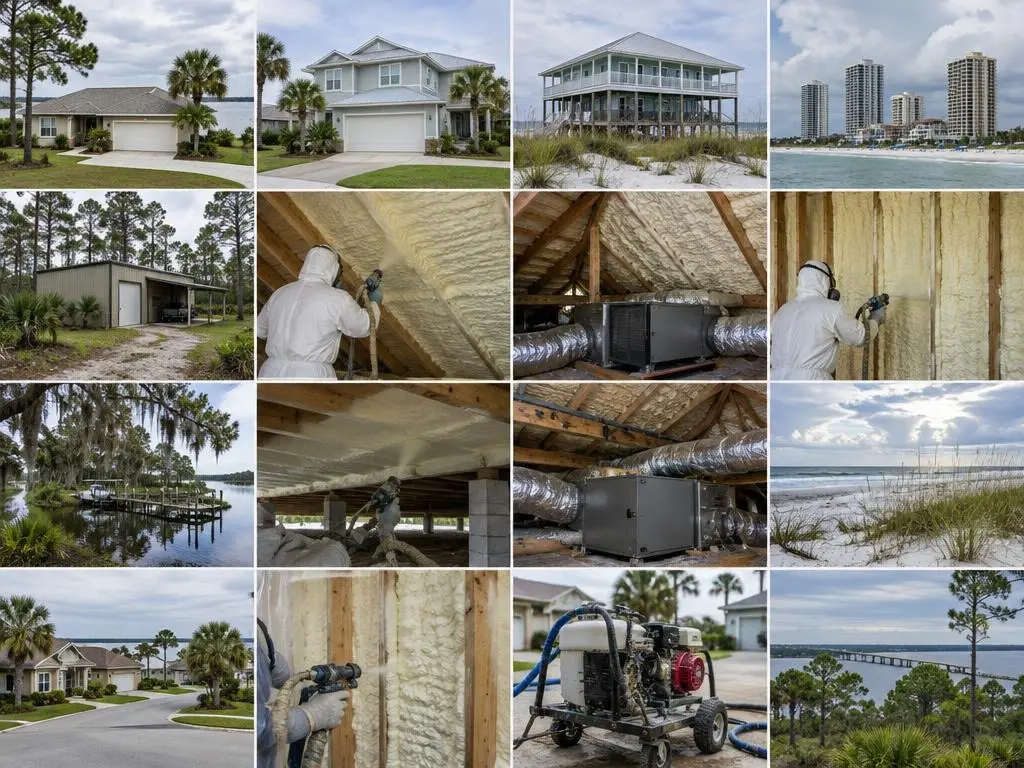
We work in Panama City and its neighbors around St. Andrews Bay: Lynn Haven, Callaway, Parker and Springfield on the mainland; Panama City Beach, Upper Grand Lagoon, Lower Grand Lagoon and Laguna Beach on the beach side; Southport and Fountain to the north; Mexico Beach to the east; Port St. Joe and Wewahitchka in Gulf County; Inlet Beach on the Walton County line; and Sunny Hills in Washington County. The beach communities hold a lot of raised homes, condos and second homes, the mainland cities more slab-on-grade houses from every decade, and the northern rural areas more shops, barns and metal buildings. Each town page covers what is different there.
- Spray Foam Insulation in Panama City, FL
- Spray Foam Insulation in Panama City Beach, FL
- Spray Foam Insulation in Lynn Haven, FL
- Spray Foam Insulation in Callaway, FL
- Spray Foam Insulation in Parker, FL
- Spray Foam Insulation in Springfield, FL
- Spray Foam Insulation in Upper Grand Lagoon, FL
- Spray Foam Insulation in Lower Grand Lagoon, FL
- Spray Foam Insulation in Laguna Beach, FL
- Spray Foam Insulation in Mexico Beach, FL
- Spray Foam Insulation in Southport, FL
- Spray Foam Insulation in Fountain, FL
- Spray Foam Insulation in Wewahitchka, FL
- Spray Foam Insulation in Port St. Joe, FL
- Spray Foam Insulation in Inlet Beach, FL
- Spray Foam Insulation in Sunny Hills, FL
Common Questions
How much should I expect to pay for spray foam insulation?
HomeGuide's national range is $1.50 to $5.00 per square foot installed: $1.50 to $3.50 for open-cell and $3.00 to $5.00 for closed-cell. A spray foam attic runs $3,000 to $8,000 in that guide. Thickness, access and any removal change the total, and the written estimate after our visit is the price.
How much does it cost to spray foam 1,500 or 2,000 square feet?
It depends on what the square footage measures. Spraying 1,500 square feet of roof deck or wall at HomeGuide's $1.50 to $5.00 per square foot works out to roughly $2,250 to $7,500, and 2,000 square feet to roughly $3,000 to $10,000. A 2,000 square foot house has much more than 2,000 square feet of wall and roof surface, so HomeGuide's whole-house range of $8,000 to $20,000 is a better guide for doing everything.
Why do some people call spray foam a red flag?
Usually because of poor installs or because foam on the roof deck hides the underside of the roof from a home inspector. Foam sprayed too thick in one pass, mixed wrong or put over a leaking roof can cause odor, gaps or hidden rot. We spray in proper lifts, fix leaks first and give you a written record of what was installed and where.
Should I use closed cell or open cell spray foam in Panama City?
Open-cell is the usual pick for the underside of the roof in a sealed attic because it fills the rafter bays for less money. Closed-cell suits raised floors, metal buildings and tight spaces because it is denser, higher in R-value per inch and slows vapor. Your quote names the foam for each area.
What is the attic insulation requirement in Florida?
The 2023 Florida Building Code, Energy Conservation, lists R-38 for ceilings in Climate Zone 2, which covers Bay County. That applies to new work. For an existing attic with little insulation, the Department of Energy recommends R-49 to R-60 in Zone 2.
Is a sealed attic a good idea in a humid climate?
It can be, especially when ducts and the air handler are in the attic. The roof deck has to be dry and the foam thick enough, and the attic vents get closed off as part of the job. We check the roof and the equipment first and explain whether a sealed attic or a sealed ceiling with blown-in fits your house.
How long do we need to stay out of the house after spraying?
HomeGuide advises staying out for at least 24 hours while spray foam cures. We ventilate the work area during and after spraying and give you a time to return when we schedule the job.
Can spray foam help a house hold up in a hurricane?
Foam is insulation, not a storm system. What it does well here is seal air leaks and, in the case of closed-cell, add stiffness to the surface it bonds to. Roof attachment, straps and openings are what building codes rely on for wind, so do not choose foam for storm protection alone.
What We Insulate
Six kinds of work, matched to each part of the building, from foam under the roof deck to clearing out insulation the last storm ruined.
Spray Foam Insulation
Open-cell or closed-cell foam that stops air leaks and slows heat in walls, roof decks, floors and buildings.
Learn more →Sealed Attic & Roof Deck Foam
Move the insulation to the roof deck so your ducts and air handler sit inside a sealed, cooler attic.
Learn more →Blown-In Attic Insulation
Seal the ceiling, then blow cellulose or fiberglass deep across the attic floor for the lowest cost per R-value.
Learn more →Crawl Space & Raised Floor Insulation
Insulate and seal under raised homes and crawl spaces so floors stay comfortable and the space below stays drier.
Learn more →Metal Building & Pole Barn Insulation
Closed-cell foam that stops steel buildings from dripping and cuts the heat that pours through a metal roof.
Learn more →Insulation Removal & Replacement
Clear out wet, dirty or pest-ruined insulation and replace it with something that works.
Learn more →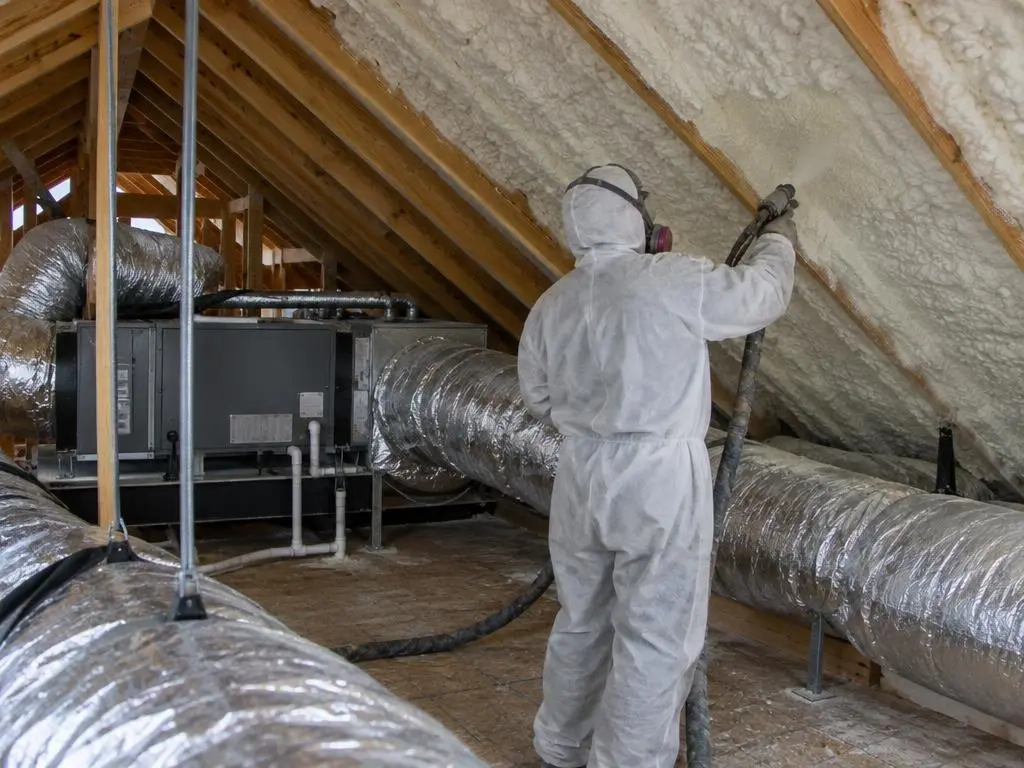
Why Homeowners Call Spray Foam Insulation Panama City
We look before we price
Every quote follows a visit to the attic, the crawl space or the building. No numbers over the phone.
Ducts and equipment considered
We note where your ducts and air handler sit, because that decides whether a sealed attic or a sealed ceiling makes more sense.
Moisture first
Roof leaks, wet decking and bath fans venting into the attic get called out before any insulation goes in.
Quotes you can compare
Each area lists material, thickness or depth, target R-value and price on its own line.
Get a Spray Foam Insulation Estimate in Panama City
We come out, look at the attic and the rest of the building, and send a written price that lists material and R-value for each area.